
Audio
History & Identity · Reflection 01
Africa's Wealth
Reclaiming leadership and prosperity — tracing the continent's economic renaissance from colonial extraction to sovereign growth.

Audio documentaries and panel recordings exploring the ideas, leaders and moments that are shaping Africa's trajectory.
History & Identity · Reflection 01
Reclaiming leadership and prosperity — tracing the continent's economic renaissance from colonial extraction to sovereign growth.
History & Identity · Reflection 01
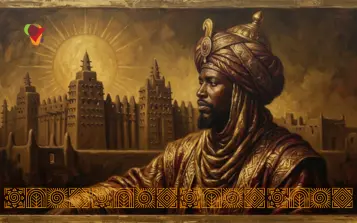
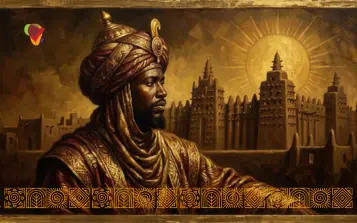
Long before colonial extraction, Africa's wealth was the envy of the world. The trans-Saharan trade routes, the gold of the Ashanti, the scholarly wealth of Timbuktu — these were not the foundations of poverty, but of civilisation.
The continent's economic story did not begin with colonisation and it does not end there.
This documentary traces the arc of Africa's economic potential — from the ancient kingdoms that commanded global trade, through the structural disruptions of the colonial era, to the sovereign economies now reclaiming their inheritance.
Nairobi's innovation corridors, Lagos's fintech ecosystem and Kigali's governance model are not aspirational outliers. They are the visible edge of a continental economic transformation already underway.
Africa's Wealth is not a forecast. It is a reckoning with what was always there.
History & Identity · Reflection 02
The vision that birthed Africa's most consequential democratic movement — and the ideas still shaping the continent's political imagination.
History & Identity · Reflection 02
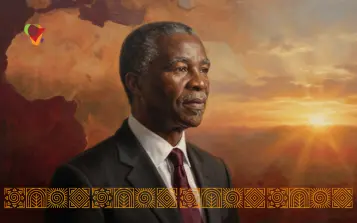
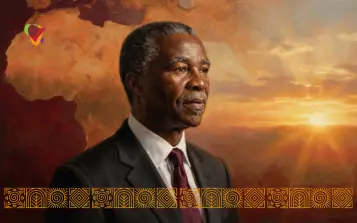
In 1996, Thabo Mbeki stood before the world and declared: “I am an African.”
His African Renaissance speech was not nostalgia, it was a manifesto. Mbeki called for Africa to reclaim its destiny: to end poverty, build democratic institutions and restore the continent’s place as a producer of knowledge, not just raw materials.
He envisioned an Africa that would “no longer be a passive onlooker” but an active architect of its own future, economically self-reliant, politically united and culturally proud.
Nearly three decades later, that vision pulses through every young entrepreneur in Lagos, every health advocate in Nairobi, every policy-maker at the African Union.
The African Renaissance is not abstract philosophy. It is a blueprint — one that Mbeki articulated and a new generation is now building, brick by brick.
The Renaissance was spoken into existence. Now it is being lived.
History & Identity · Reflection 03
The renaissance is here — a portrait of the ideas, institutions and individuals driving Africa's most ambitious political and cultural renewal.
History & Identity · Reflection 03
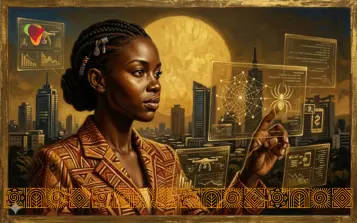
Africa is not waiting for permission to rise — it is already building its future.
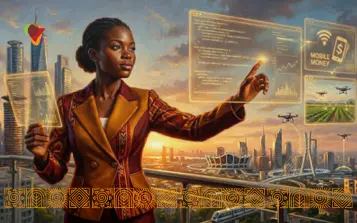
From Nigeria’s Yabacon Valley to Kenya’s Silicon Savannah, young innovators are creating homegrown solutions that leapfrog traditional barriers. Mobile money has revolutionized finance, putting banking in the hands of millions who never had a bank account. Startups are solving African problems with African ingenuity — in fintech, healthtech and agritech.
This is more than technology. It is a movement.
A new generation is blending ancestral wisdom with digital tools, channeling the creativity of Anansi tales into code and commerce. The result: economic empowerment, cultural pride and continental self-determination.
The narrative has shifted. Africa is no longer defined by what was taken — but by what is being built.
The Renaissance is not coming. It is here.